
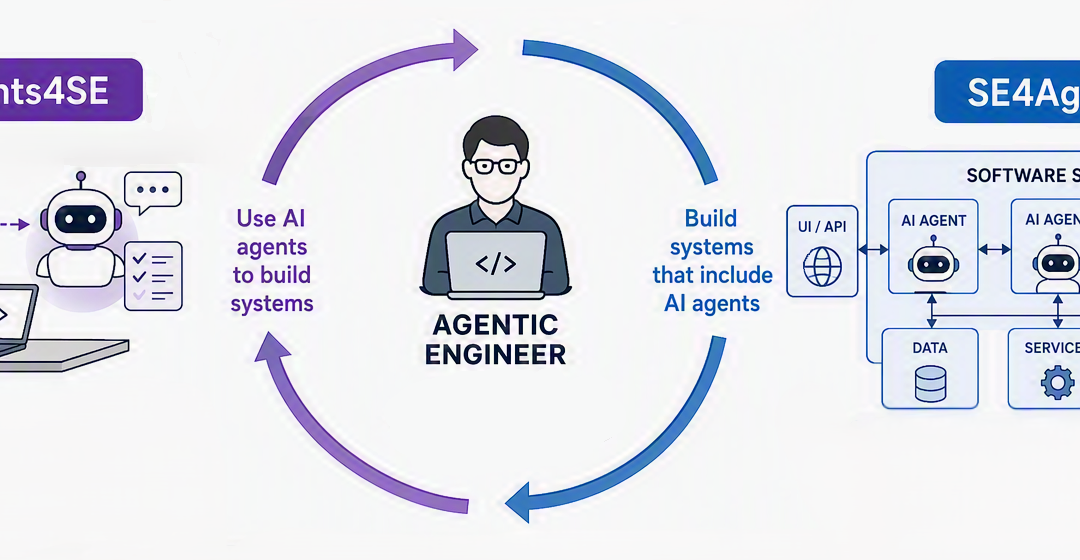
In one of my earlier posts I wrote about the developments in software engineering in the age of AI, GenAI and LLMs. I identified that AI agents are the next step in LLM systems. But developments are going real fast. Next to new engineering practices for agent-based systems (Serban, 2025), we also see the advent of more and more agent-based tools and systems for software engineering tasks. These developments lead to the emergence of a new software engineering discipline that has been coined Agentic Engineering (Karpathy, 2026). In this post I describe that new discipline, with definitions, concepts, tools and frameworks that I have found until now.
Agentic Engineering: SE4Agents & Agents4SE
I would like to extend the definition of Karpathy (2026) because I feel that Agentic Engineering should consider this double loop of building systems using AI agents, while at the same time the systems we build can have AI agents as components in the system. Both sides of that coin require the agentic engineer to be both skilled in software engineering as well as in AI agents.
So, for me, Agentic Engineering =
SE4Agents: building production-ready agent-based systems
+
Agents4SE: using AI agents to build production-ready software systems
As I said in my previous post the software engineer with AI tooling becomes less of a “builder” and more of an end-to-end problem solver. So, a more appropriate definition[1] for Agentic Engineering would be:
Agentic Engineering = a mix between principles, tools, and techniques of Agentic AI and traditional Software Engineering to solve problems
Agents4SE
When developing software using agents the following publications/links are useful to consider:
- The 2026 Agentic Coding Trends Report and Kam et al. (2025) describe the changes to the Software Development Lifecycle (SDLC). There are also changes to the developer tool stack, making tools more suitable for agents, like Cursor Origin.
- Kam et al. (2025) lists DevOps tasks that can be automated with AI, with an extensive appendix on how to do this. Agents can be useful for many different software engineering tasks (not just code generation), see for example the Ish platform that uses agents for user testing and the Harness platform that offers agents for the whole SDLC.
- NxCode (2026) provides high-level lessons learned on moving from vibe coding to agentic engineering. Hassan (2026) has written a complete book for managers on how to reshape software engineering teams with AI teammates.
- Unblocked (2026) describes maturity levels for context engineering plus good practices to move up to the next maturity level. Storey (2026) argues that with agents building our software we will not only have to deal with technical debt, but also with cognitive debt, and intent debt. She describes several practices for mitigating them. Tornhill (2026) describes 6 operational patterns for reliable agentic coding.
- There are many new tools and frameworks arising around agentic SE, such as A2UI. A2UI is an open standard and set of libraries that allows agents to “speak UI.” Agents send a declarative JSON format describing the intent of the UI. The client application then renders this using its own native component library (Flutter, Angular, Lit, etc.).
- Developers from Codex | OpenAI describe lessons learned from a real-world example where they tried to develop a working product for real customers without writing a single line of code themselves. Owaino (2026) describes how he built an agentic SDLC with Spec Kit, Azure and Github.
- In my previous post I also described the human aspects of changing from manual coding to AI-augmented SE. I would like to refer to that post and Alenezi (2026) if you want to read more about this.
SE4Agents
When developing agent-based systems the following publications/links are useful to consider:
- Roitman (2026) wrote an extensive book (600+ pages) covering all aspects of Agentic AI because “practitioners need a single, unified reference that covers the entire stack — not just the theory, but the implementation details that make things actually work.” His work starts with mathematical foundations and ends with how to build multi-agents systems.
- Yin (2026) explains how with agents we move from prompt engineering to context engineering (information) to harness engineering (tools, guardrails, validation, knowledge). Osmani (2026) explains how you can use loop engineering on top of that, defining recursive goals instead of prompting single agents.
- One of the most important parts of agent systems are the skills files (md). As these are simple markdown files, it is hard to test and debug them. Microsoft released SkillOpt that could help optimize skills in a more structured way.
- Confluent (2026) describes how event-driven design can help to build scalable multi-agent systems. BCG (2025) describes the enterprise tech stack (the infrastructure) needed for building such systems.
- In my previous post I already indicated that with agents we move from MLOps to LLMOps to AgentOps. Xia et al. (2025) describe such AgentOps patterns.
- MCP servers are the means to connect agents to data sources and tools. The Model Hardware Standard aims to develop a similar standard protocol for the connection of agents to hardware.
- Kulkarni (2026) describes a case study building a production-ready Agentic AI system for Bayer. He reflects on key engineering decisions through the lens of context engineering and harness engineering.
Conclusion
In this post I defined agentic engineering as a new discipline within software engineering that combines both Agents4SE and SE4Agents. There is not much consensus yet on methods, tools, and frameworks for agentic engineering as developments in industry are going faster than theory can develop. The good news is that principles and techniques from traditional software engineering still hold and are now more important than ever. Requirements engineering, verification-driven engineering, security by design, etc.; it is all a prerequisite for building reliable agentic systems and using agents reliably for building production-ready systems. I will keep you posted.
References
Alenezi (2026). Rethinking software engineering for agentic ai systems. arXiv preprint arXiv:2604.10599.
BCG (2025) From Apps to Agents: How the AI-Native Tech Stack Is Transforming Software
Burkov, A. (2020). Machine learning engineering. True Positive Inc.
Confluent (2026). A Guide to Event-Driven Design for Agents and Multi-Agent Systems
Hassan (2026) AgenticSE_Book.pdf
Kam et al. (2025) “What do professional software developers need to know to succeed in an age of Artificial Intelligence?.” Proceedings of the 33rd ACM International Conference on the Foundations of Software Engineering.
Karpathy (2026) Andrej Karpathy op X
Kulkarni (2026) Building Reliable Agentic AI Systems
NxCode (2026) Agentic Engineering: The Complete Guide to AI-First Software Development Beyond Vibe Coding
Osmani (2026) Loop Engineering | AddyOsmani.com
Owaino (2026) An AI led SDLC: Building an End-to-End Agentic Software Development Lifecycle with Azure and GitHub. | Microsoft Community Hub
Roitman (2026). The Hitchhiker’s Guide to Agentic AI: From Foundations to Systems. arXiv preprint arXiv:2606.24937.
Serban (2025) SE-ML | Engineering LLM-Based Agentic Systems and SE-ML | Agentic Coding
Storey (2026). From technical debt to cognitive and intent debt: Rethinking software health in the age of AI. arXiv preprint arXiv:2603.22106.
Tornhill (2026) Agentic AI Coding: Best Practice Patterns for Speed with Quality
Unblocked (2026) Context Maturity: 8 Levels of AI Engineering
Xia et al (2025) AgentOps Pattern Catalogue: Architectural Patterns for Safe and Observable Operations of Foundation Model-Based Agents
Yin (2026) What Is Harness Engineering for AI Agents? | Milvus – Milvus Blog
[1] Adapted from the definition of Burkov (2022) for ML Engineering

 Vind ik leuk

Over Petra Heck
Petra werkt sinds 2002 in de ICT, begonnen als software engineer, daarna kwaliteitsconsultant en nu docent Software Engineering. Petra is gepromoveerd (kwaliteit van agile requirements) en doet sinds februari 2019 onderzoek naar Applied Data Science en Software Engineering. Petra geeft regelmatig lezingen en is auteur van diverse publicaties waaronder het boek "Succes met de requirements".